

Natural Looking Dermal Fillers in Henderson: A Guide

Last Updated: November 1, 2026
Quick Summary
Natural-looking dermal fillers in Henderson are hyaluronic acid gels placed in conservative amounts where volume has been lost, so your face still moves and reads as your own. The right product and placement depend on your facial anatomy and goals, which a provider should assess in person at a consultation.
A natural result means the treated area matches the rest of your face in size and fullness.
Expression lines should soften without the face losing its ability to animate.
Hyaluronic acid fillers can be dissolved with hyaluronidase, unlike some non-HA fillers.
Lips and perioral lines typically lose product faster than midface volume.
Avoid choosing a result based on a single photo or a celebrity's face.
Table of Contents
What Natural-Looking Dermal Fillers Actually Mean
Dermal fillers are injectable gels, most commonly made from hyaluronic acid, used to restore volume, smooth lines and add definition to the face (the FDA). When people ask for natural-looking dermal fillers in Henderson, they usually mean something specific: they want to look rested and refreshed, not like they have had work done. That goal shapes every decision that follows, from which product is chosen to where it is placed and how much is used.
At Veristic Aesthetics, a natural result means the face still moves, expresses and reads as your own.
A natural outcome is usually the product of restraint, with conservative amounts placed where volume has been lost. An expert panel writing in a 2026 article indexed by PubMed Central review of safe and natural hyaluronic acid filler outcomes identified the factors that matter most when selecting hyaluronic acid fillers for a natural result, and the same principles guide treatment planning here.
Three things define a natural-looking result:
Proportion: The treated area matches the rest of your face in size and fullness.
Movement: Expression lines soften without the face losing its ability to animate.
Texture: Skin looks smooth and healthy, not stretched or overly shiny.
Watch out: the most common mistake is asking for a result based on a single photo or a celebrity's face. Your facial anatomy, bone structure and skin quality are not the same as theirs, so a result that looks right on someone else can look wrong on you.
Dermal Filler Treatment Areas and Where Volume Matters Most
Volume loss is rarely uniform. Fat pads shift, bone resorbs slightly and skin thins over the years, so the areas that need attention vary from person to person. In most treatments, the cheeks, temples, jawline, lips and lines around the mouth and nose are the most common targets.
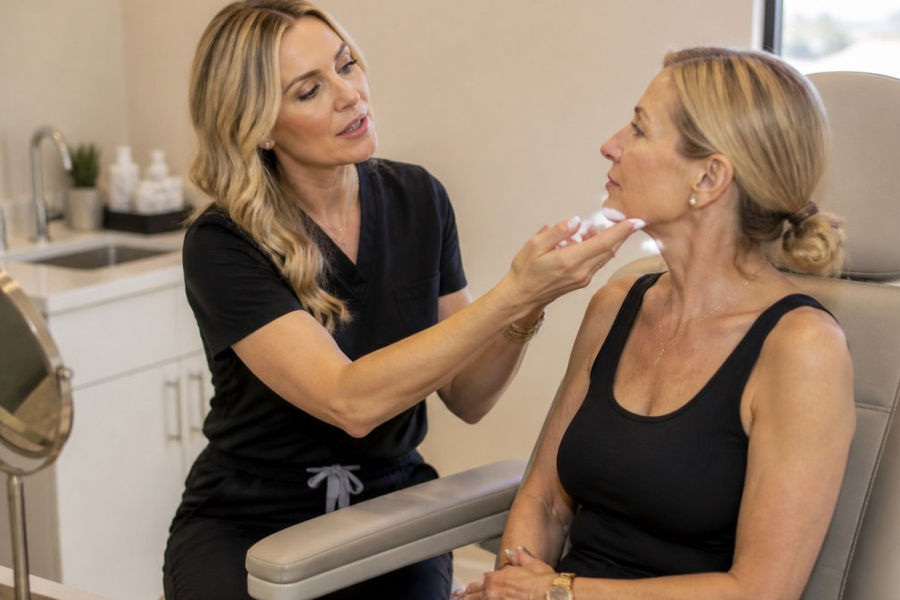
Cheeks and midface are often the starting point for a refreshed look. Restoring fullness here can lift the lower face and soften the lines that run from the nose to the mouth. Temples respond well to small amounts, and adding volume there can change how the whole upper face reads. Lips and perioral lines require careful balance so the result stays in proportion with the rest of the face.
The right area depends on what you want to change, and a provider should assess it in person. A consultation at our Henderson clinic starts with a look at how your face moves and where volume has been lost, so that treatment addresses the actual problem rather than a generic list of targets.
Types of Hyaluronic Acid Fillers and How They Differ
Most dermal fillers used today are hyaluronic acid (HA) products, a substance the body already produces. The main differences between them lie in how firm the gel is, how it is cross-linked, how it is designed to be used and how it is labeled for approved areas. Understanding those differences is what lets a provider match a product to an area and a goal rather than reaching for a single default.
Products are generally grouped by their intended use. Some are formulated for fine lines near the surface of the skin, while others are denser and designed to add structure and volume deeper in the face. Some are approved for specific treatment areas, such as the lips or under-eye area, and others for the cheeks or jawline. Not every product is approved for every use, so the labeling matters.
A useful way to compare HA fillers is by three properties:
Firmness (G-prime): Softer gels spread and blend under thin skin, which suits lips and fine lines. Firmer gels hold shape and resist compression, which suits cheeks, temples and jawline structure.
Longevity: Products designed for structural support tend to last longer than soft gels placed in high-movement areas. Lips and perioral lines typically fade faster than midface volume.
Reversibility: All HA fillers can be dissolved with hyaluronidase, an enzyme that breaks down the gel. This is a meaningful safety feature and a reason HA products are often preferred over permanent alternatives. Non-HA fillers, such as those made from calcium hydroxylapatite or poly-L-lactic acid, are not reversible in the same way and behave differently over time.
At Veristic Aesthetics, we use hyaluronic acid fillers and select the product based on the area, the amount of volume needed and the result you want. The brand you receive is less important than the technique and the placement. Our treatment planning is explained in more detail at U.S. Food and Drug Administration guidance on dermal fillers.
Watch Out Be cautious of any provider who recommends a single product for every concern. Matching the filler to the area and the goal is a core part of achieving a natural result, and asking whether a recommended product is reversible is a fair question.
The main HA filler properties that set products apart are summarised below.
Property | What it means | Why it matters |
Firmness (G-prime) | How firm the gel is | Softer gels suit lips and fine lines; firmer gels suit cheeks and jawline |
Longevity | How long results last | Structural products tend to outlast soft gels in high-movement areas |
Reversibility | Can be dissolved with hyaluronidase | HA fillers can be dissolved; non-HA fillers behave differently |
How Long Do Dermal Fillers Last and What Affects Longevity
Hyaluronic acid fillers are not permanent, and results gradually fade as the body breaks the gel down. How long a treatment lasts depends on the product, the area treated, the amount injected and your individual metabolism. Results vary widely from person to person.
Several factors influence longevity. Areas with more movement, such as the lips, tend to lose product faster than areas that move less. Sun exposure, smoking, weight changes and general skin health can all shorten the timeline. Larger volumes do not always last longer than smaller ones; the placement and the product choice often matter more.
Your provider can give a realistic estimate after assessing your face and goals.
Building a Personalized Dermal Filler Treatment Plan
A personalized plan starts with your goals and ends with a result you can live with. It is not a list of procedures bought off a menu. It is a sequence of decisions about which areas to treat, which products to use and how to space appointments.
A good planning process typically includes a discussion of your aesthetic goals, an assessment of your facial anatomy and an honest conversation about what is realistic.
Our team at Veristic Aesthetics also considers the rest of your care. Holistic medicine is part of how we think about skin health, so a plan may include other services in our office, such as PRP therapy options at our Henderson clinic, if they fit your goals. Treatments are sequenced with safety and recovery in mind.
Questions to Ask at a Dermal Filler Consultation
A consultation is the most useful tool you have for judging whether a provider is the right fit. Come prepared with specific questions rather than relying on the provider to lead the conversation.
Useful questions include:
What is my assessment of the areas you would treat, and why?
Which product do you recommend, and why that one for my goals?
What result would you consider a natural outcome for my face?
How many treatments do you expect I might need, and how are they spaced?
Who will perform my treatment, and what is their training?
What should I expect during recovery, and when should I call the office?
A provider who answers these clearly and without pressure is usually a good sign. A provider who pushes for a large treatment on the first visit is a reason to slow down and ask more questions.
How to Choose a Qualified Injector in Henderson
Choosing an injector is the decision that most affects your result and your safety. Look for a provider who is licensed, trained in facial anatomy and experienced with the specific treatments you want. Ask who will actually inject you, not only who runs the practice.
At Veristic Aesthetics, our team includes Jessica Leduc, D.O., who is board-certified in emergency medicine and a Fellow of the American Academy of Emergency Medicine; Mandy Griffin, MPH, PA-C; and Chloe Longman, Advanced Esthetician. Credentials vary by role, so ask what each person is trained to do and how that training applies to your treatment.
Some practical checks help. Ask to see before-and-after photos of similar treatments, and ask how the provider handles complications. A confident injector will explain both the benefits and the limits of a treatment without overpromising.
Risks, Side Effects, and Warning Signs to Watch For
Dermal fillers are medical procedures and carry real risks. A balanced understanding of those risks, and of who should not be treated, is part of choosing care responsibly.
Common side effects include swelling, bruising, tenderness, redness and mild lumpiness at the injection sites. These usually settle within a few days to a couple of weeks. Bruising is more likely in areas with many small vessels, such as the lips and under-eye area, and in people who take blood thinners or certain supplements.
Less common complications include infection, persistent lumps or nodules, and in rare cases injection into a blood vessel. Vascular occlusion, where filler blocks blood flow, can affect the skin or, in very rare cases, vision. This is why experienced injectors use techniques such as aspiration, small aliquots and knowledge of facial vascular anatomy, and why they keep hyaluronidase available to dissolve HA filler if needed.
Who should postpone or avoid treatment:
People who are pregnant or breastfeeding
Anyone with an active skin infection or inflammation in the treatment area
People with known allergies to the product or its components, including lidocaine in some formulations
Those with certain autoimmune or bleeding disorders, after provider review
Anyone with unrealistic expectations or who is under pressure to treat
Watch Out Seek medical care right away if you notice severe pain that worsens over time, skin that turns pale, blue, dusky or mottled, vision changes or loss, or signs of infection such as spreading redness, heat and fever. Do not wait to see whether these symptoms improve on their own, early treatment matters.
A provider who explains both the benefits and the limits of treatment, and who has a clear plan for complications, is a better sign of safety than one who promises a perfect result with no risk.
Preparing for Your Appointment and Aftercare
Preparation helps reduce bruising and supports a smoother recovery. Your provider may ask you to avoid blood-thinning medications, alcohol and certain supplements for a period before treatment, but check with your provider about what applies to you.
After treatment, avoid strenuous exercise and heat exposure of the treated area for the time your provider recommends. Some swelling is normal, and it often peaks within a few days before settling. Follow the aftercare instructions you are given, and keep your follow-up appointment so your provider can check the result.
For more on what to expect, read our guide on how long lip filler swelling lasts.
Frequently Asked Questions
How can dermal fillers look natural?
Natural-looking results usually come from conservative volume placed where facial volume has been lost, rather than from maximizing the amount injected. A provider evaluates facial anatomy, movement, and your stated goals before choosing a product and technique. Staged treatment, where a smaller amount is added and reassessed after two weeks, also helps avoid an overfilled look. Discuss your goal of subtle refreshment during the consultation so the plan reflects it.
Which areas can dermal fillers treat?
Dermal fillers are commonly used for the cheeks, lips, temples, under-eye hollows, nasolabial folds, and marionette lines, among other areas. Each area responds differently to volume and requires a different product and injection technique. A consultation with a qualified provider helps determine which areas are appropriate for you. Fillers are approved by the U.S. Food and Drug Administration for specific indications, so confirm that your intended use matches those indications.
How long do dermal fillers last?
Hyaluronic acid fillers typically last several months to about a year or more, depending on the product, the treated area, and individual factors such as metabolism and activity level. Results gradually fade as the body absorbs the product. Maintenance treatments are usually scheduled to keep results consistent. Your provider can give you a realistic estimate based on the product and area chosen during your consultation.
What should I ask during a dermal filler consultation?
Ask about the provider's training and credentials, which products they recommend and why, how they plan treatment for your facial anatomy, and what results you can realistically expect. Ask how they handle swelling, bruising, and complications, and what follow-up care is included. You should also ask whether they will reassess you after treatment and how they approach your overall health and any other treatments you are considering. Use the consultation to decide whether the provider's approach fits your goals.
How do I choose the right dermal filler treatment?
The right treatment depends on the area you want to address, your facial structure, the result you want, and how long you want it to last. A provider compares product types and treatment techniques against those factors. Ask the provider to explain why a specific product is recommended for your situation rather than accepting a generic plan.
Book Your Natural-Looking Consultation at Veristic Aesthetics
If you are considering dermal fillers in Henderson and want a result that looks like you, a consultation is the right first step. At Veristic Aesthetics, our team focuses on natural-looking results, individualized treatment plans and a calm, patient-centered experience from start to finish. Schedule your visit to discuss your goals and find out which approach fits your face.



Comments